

HIPAA-Conscious Google Ads Conversion Tracking for Healthcare Practices
HEALTHCARE ADVERTISING GUIDE
Healthcare advertisers need enough data to optimize campaigns without treating patient information like ordinary marketing data. That tension makes conversion tracking one of the most important and most misunderstood parts of medical advertising.
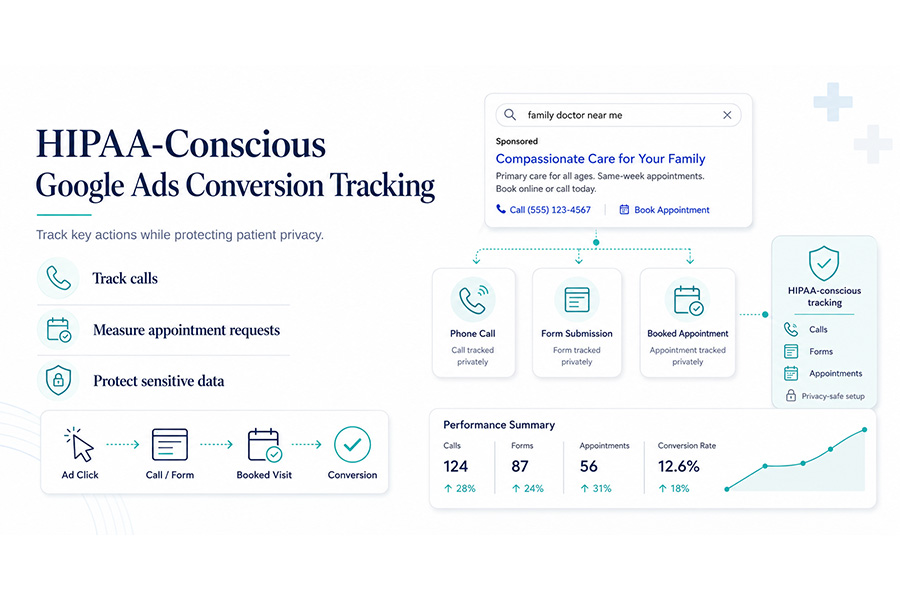
A responsible healthcare PPC measurement plan should define what Google needs to receive, what must remain inside the practice’s systems, and how leads will be connected to booked appointments without exposing unnecessary details.
This article provides a practical framework for tracking healthcare campaigns. It is not legal advice, and every practice should review its implementation with qualified privacy, security, and legal professionals.
What This Post Covers
- Choosing safe conversion actions
- Separating marketing events from clinical details
- Tracking calls and forms
- Using offline outcomes
- Reviewing vendors and data flows
- Building reports that focus on booked patients
1. Start With Data Minimization
The safest tracking plan begins by collecting and sharing less information. Google Ads generally needs to know that a valuable event occurred and, in some cases, the value or quality assigned to that event. It does not need a diagnosis, procedure description, appointment note, or patient message.
Define a small set of marketing events such as qualified phone call, appointment request, scheduled consultation, or completed new-patient visit. Keep clinical details and free-text patient information inside approved practice systems.
Data minimization also improves reporting. A short list of well-defined conversion actions is easier to audit than dozens of events named after conditions, treatments, or form responses.
Question to Answer: What is the minimum information required to optimize the campaign?
2. Map Every Tool That Receives Data
Healthcare websites often include more technology than the marketing team realizes. Analytics tags, advertising pixels, call-tracking scripts, chat tools, scheduling widgets, form platforms, heatmaps, and content-management plugins may all receive information.
Create a data-flow inventory showing what tool loads on each page, what information it can access, where the data is sent, and which team or vendor controls it. Include authenticated portals and mobile applications in a separate, higher-scrutiny review.
Do not assume a vendor is appropriate because it offers a healthcare pricing tier. Review contracts, configuration, data retention, access controls, and whether the vendor will accept the obligations required for the use case.
Question to Answer: Can the practice name every third party that receives website or app data?
3. Use Neutral Conversion Names
Conversion names and event parameters can create unnecessary exposure when they contain medical context. An event called “depression-treatment-form” reveals more than an event called “appointment_request.”
Use neutral labels that describe the marketing action rather than the condition or treatment. Avoid inserting patient-entered text, appointment reasons, provider notes, or clinical selections into URLs, page titles, event names, or advertising parameters.
The practice can preserve detailed attribution internally by storing service and location information in its own approved systems. Google can receive the generic conversion while internal reporting retains the operational detail.
Question to Answer: Do any tracking labels, URLs, or parameters reveal a condition or treatment?
4. Track Phone Calls With Clear Rules
Phone calls are often the largest conversion source for medical practices. Track calls from ads, location assets, and the website separately so the team can understand where inquiries begin.
Use a duration threshold to reduce false conversions from wrong numbers and immediate hang-ups. The appropriate threshold depends on the intake process, but the rule should be consistent and reviewed against real call outcomes.
Call recording and transcription require additional scrutiny. Confirm consent requirements, vendor terms, access controls, retention settings, and whether recordings are necessary. A campaign can often be optimized using call duration and disposition without retaining every conversation.
Question to Answer: Which calls count as qualified inquiries, and how is that decision documented?
5. Keep Forms Focused on Contact and Scheduling
Advertising forms should request only what is needed to contact the patient and begin scheduling. Long free-text fields invite people to submit detailed health information before the practice is ready to handle it through the marketing workflow.
Use structured fields where possible and avoid passing field values into analytics or advertising platforms. A successful form submission can trigger a generic conversion without sending the contents of the form.
Test the entire path, including confirmation pages, email notifications, CRM integrations, and URL parameters. Sensitive information can leak after submission even when the visible form appears simple.
Question to Answer: Does any form response appear in a URL, tag, notification, or third-party dashboard?
6. Separate Leads From Qualified Outcomes
Google Ads can optimize toward the events it receives. If every call and form is treated as equally valuable, bidding will pursue volume rather than patients who are likely to schedule and arrive.
Create an internal qualification process. The front desk or intake team can mark leads as invalid, qualified, scheduled, completed, or accepted for treatment. These stages should use neutral identifiers and controlled data transfers.
Offline conversion workflows can improve optimization, but healthcare organizations should not activate them casually. Review the fields, hashing process, consent basis, contracts, platform rules, and legal requirements before uploading or connecting any data.
Question to Answer: Which downstream event best represents a valuable patient outcome without sharing clinical detail?
7. Respect Healthcare Targeting Restrictions
Healthcare is treated as a sensitive interest area in Google’s personalized advertising rules. Advertiser-curated audience features can be restricted when campaigns promote sensitive health content, even when the underlying list was collected by the practice.
Do not assume that a website visitor list, customer upload, or audience expansion feature is available simply because it appears in the account interface. Review the current policy for the service, location, campaign type, and targeting method.
Search campaigns built around user-entered queries and appropriate location targeting are often the most straightforward starting point. Policy eligibility still depends on the specific healthcare product or service being promoted.
Question to Answer: Has every audience and data feature been reviewed against the current healthcare advertising policy?
8. Review Google Tag Manager and Consent Settings
Tag-management systems make deployment easier, but they can also allow unreviewed scripts to spread across the website. Limit publishing access, document every tag, and use approval workflows where available.
Consent settings should reflect applicable law, platform requirements, and the practice’s privacy decisions. A consent banner is not a substitute for reviewing whether a technology should be present at all.
After every website redesign, scheduling-platform change, or marketing-vendor change, repeat the tracking audit. Old tags frequently remain active after the team believes they were removed.
Question to Answer: Who can publish tracking code, and how often is the container audited?
9. Build a Reporting Layer Inside the Practice
Google Ads should report spend, clicks, calls, forms, and campaign-level conversions. The practice’s internal system should report qualified leads, scheduled appointments, completed visits, service line, location, and estimated value.
Connect the two layers using controlled campaign identifiers rather than clinical information. A weekly or monthly report can compare advertising cost with booked-patient outcomes without turning the ad platform into a patient record.
This division also improves accountability. Marketing can optimize traffic and messaging, while operations can address missed calls, scheduling delays, and low show rates.
Question to Answer: Can the practice calculate cost per booked patient without exporting clinical details to the ad platform?
In Summary
Healthcare conversion tracking should be designed around restraint. Share only what is needed to measure marketing actions, use neutral event names, audit every vendor, and keep clinical details inside approved systems.
Track calls and forms, but evaluate success through qualified and completed patient outcomes. Review audience features and data uploads against current platform policy before using them.
The strongest tracking setup is not the one that collects the most data. It is the one that produces reliable decisions with the least unnecessary exposure.